

Youth Play Script Techniques
Need a play script for a youth theater program? Have an idea, but no thoughts about how to start? An answer can be found in this post document. It offers script techniques for youth theater plays for aspiring writers (adult or youth).
Importantly, an advantage to this approach is no royalty payment due to a theater scripting house. Another advantage is that the play can be written for youth actors already participating in the program and working on acting development.
The following suggestions provide a template for a script format; a great start to the thought process of educating youth to theater.
What this post offers!
Have an idea for a play that you’ve been thinking about for a while? Well, get out the paper and pencil and start jotting down notes. The notes might not come freely or quickly, but at least the idea is documented and can be expanded upon.
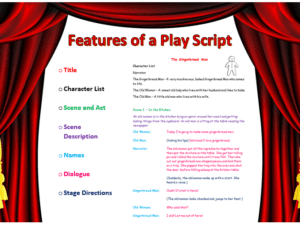
Features of a Play Script
Ideas come at all times of the day and night: While cooking dinner, driving in the car, watching television, listening to the radio, hearing a phrase from a friend or words of wisdom – there is no limit on the circumstances.
Breaking down the ‘Features of a Play Script’ from the picture shown. Each topic will be identified and defined to help a novice or experienced script writer.
-
Know the Age of the Group of Actors and the type of script content appropriate for each:
- Early Elementary (Ages 5 – 8) – short scripts with simple dialog/wording, easy lesson to be learned from the story
- Middle Elementary (Ages 9 – 12) – deeper complexity of characters, more pointed dialog (humor, seriousness), and with specific detail resolution to the topic of the story
- Teenagers (Ages 13 – 18) – broad definition of characteristics of actors, more maturity in script content, more personality in the dialog – humor, satire, irony, …
-
Character List – Human: Focus on the age/maturity of the actor
- Being able to identify with the character is vital to the success of casting the play and to the success of presentation.
- If a young actor doesn’t comprehend what the traits are of an assigned character, then the connection between the actor and the character or the actor and the audience will be lost.
- There is always a strong personality amongst the kids that audition for the play.
- Make sure that lead characters are appropriately cast to encourage those stronger actors and to make younger actors less intimidated about what they are being asked to do.
- Everyone who auditions should be cast in the play.
- Assign stage crew, costume management, make-up opportunities to auditioners who need time to consider taking the stage.
-
Character List – Animated: Focus on the age/maturity of the actor
- Sometimes the storyline might involve animated characters (human actors) to make the actors feel comfortable or more secure.
- Fairytale people, creatures, or animals are a good adaptation for some plays. (Alice in Wonderland comes to mind) The script might suggest use of animated props – stuffed animals, puppets, hats, etc.
-
Scene or Act Definition/Description –
- Depending on the script idea, organize the play to give everyone the understanding of content depth.
- One – Act Play: usually runs 10 – 30 minutes – great for young actors to try their wings or to be performed outdoors or at a school assembly
- Full – Length Play: usually runs 45 – 90 minutes (with 15 minute intermission if approaching 90 minutes)
- Musical Play or Variety Show: usually runs 60 minutes with smaller acts/scenes – complete with songs and dance routines –
- Great to involve the kids in this one – a variety show of sorts makes for fun entertainment for the presenters/actors and by their involvement in the music and dance selection there is more ownership and comfort in the presentation.
-
Character Names/Descriptions –
- Name each character that both identifies them (M/F) and reflects the desired personality – braver, shy, talking as human or creature.
- Often a play has a character that can be cast by either a boy or girl. This offers the opportunity for more youth involvement.
-
Script Dialog Examples –
- Some scripts have the characters walk on and their mannerisms define their characteristics or personality – sneaking on stage, bold entry, heroic stance, …
- Some scripts require the dialog to explain or define the character
- There should always be at least a three-pronged structure to the script
- Beginning – laying the foundation for the story/plot
- Middle – characters interacting to displaying the script
- End – resolution to the situations presented in the script
-
Staging of the Play – Administrative Obligations – Separate from Entire Group
- Writing/Finalizing the script - here are some guidelines to follow for continuity with future scripts: Sample Format for Script
- Select the venue for the production
- Set date for the play based on venue availability
- Hold auditions for casting the play
- At the auditions, get a list of schedule conflicts which might occur from each auditioner.
- Given information about any schedule conflicts, cast the play
- Notify participants of their character and confirm any scheduling conflicts
- Setting the rehearsal schedule.
- Set the date for first cast gathering where scripts are handed out and the description of the process is explained
- Advertising and Team building – parents and crew
Staging of the Play – Actors Perspective
- Make the Staging Exciting for the actors too – COOL LOOKING
- Sets and Scenery
- Props
- Make-up needs
- Costumes
-
Workshopping the Play – Getting the cast involved
- Read-through of the script out loud with the actors reading their own parts
- Make sure that each actor understands their assigned role
- Listen for word pronunciation – some word vocalizing can be corrected; some wordsmithing is ok without changing the meaning to meet the needs of the actor
- Define and identify key words so that the meaning of the line or dialog isn’t compromised.
- Remember – the next stage star actor might be involved in the play – so
- Give each actor the opportunity to take the stage with confidence and to SHINE in their role
- Have older (maybe more experienced) actors mentor or work with the younger ones – ‘a possible big brother/sister situation’
